


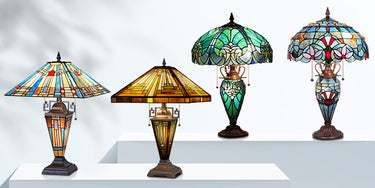
What Size Tiffany Table Lamp Do You Need? A Practical Guide for Your Home
A lamp can look beautiful on its own and still feel too large, too small, or awkward once you bring it home. The easiest way to avoid that mismatch is to measure your space before choosing your design.
When shopping for a Tiffany-style table lamp, consider more than its overall height. Shade width, base size, nearby furniture, and how you plan to use the light all affect whether it will work in your room.
This guide from TiffanyLampUSA offers a practical way to compare those details, whether you are decorating a bedside table, a living-room side table, or a reading corner.

Start with the Table, Not the Lamp
Before browsing, measure the surface where your lamp will sit. Record its width and depth, then note what else needs to stay there.
A bedside table might also hold a phone, a book, and a glass of water. A living-room side table may need room for a remote or a drink. The lamp should fit alongside those everyday items rather than take over the entire surface.
Check the base dimensions for placement, but do not stop there. A shade can extend well beyond the base, so its width matters too.
A useful first step is to mark the proposed base footprint with paper. Then use a separate paper outline to visualize the shade’s widest dimensions. This helps you see whether the lamp could crowd a wall, curtain, or nearby walkway.
Read Height and Shade Measurements Carefully
“Lamp height” and “shade height” are not the same measurement.
Look for the overall assembled height when deciding how tall the lamp will appear beside your furniture. Check the shade dimensions separately to understand its visual width and shape.
For a round shade, the listing may give a diameter. For a square or rectangular shade, look for both width and depth. Do not assume a single number describes every dimension.
If a product listing does not clearly identify a measurement, ask for clarification before ordering.

Choosing a Lamp for a Bedside Table
A bedside lamp needs to work with both your nightstand and your bed.
Think about where your eyes will be when you sit up to read. Depending on the shade and your position, a visible bulb can be uncomfortable to look toward. Consider how the shade’s lower edge and bulb placement relate to your usual seated position.
Also check whether the switch will be easy to reach without leaning across the table. Leave enough space for your usual bedside items, and plan a cord route that does not cross a walking path.
If your nightstand is narrow, start by comparing lamps with smaller shade dimensions. A compact base alone does not necessarily mean the whole lamp will fit.
Choosing a Lamp for a Living-Room Side Table
In a living room, the lamp becomes part of a larger arrangement.
Compare its size with the sofa or armchair beside it. A broad shade can make a strong decorative statement, while a smaller lamp may leave more open space on the table.
Sit in your usual position and imagine the lamp beside you. Will it block a view across the room? Could its shade sit too close to your shoulder? Is there room to place a drink comfortably?
For a simple size check, hold a tape measure to the listed overall height and shade width while someone else views the arrangement from across the room. This will not reproduce the lamp’s appearance, but it can help you judge its scale.
Choosing a Lamp for a Reading Corner
A cozy glow and useful reading light are not necessarily the same thing.
A Tiffany-style shade can contribute color and atmosphere, but reading comfort also depends on the particular lamp, the bulb, its position, and the other light in the room.
Review the product’s bulb requirements and maximum wattage before choosing a bulb. Do not assume every decorative table lamp will provide the same amount or direction of light.
If you plan to read regularly, consider how light will reach the page. You may want a separate task light alongside a decorative lamp rather than expecting one fixture to do everything.
Compare the Shade in Lit and Unlit Photos
Size is only part of the fit. Color and pattern influence how prominent the lamp feels in a room.
Where available, compare photographs of the same lamp switched off and illuminated. Glass colors can appear different under different lighting conditions, and your screen may not reproduce them exactly.
Look for connections with your room’s existing colors. A shade that echoes a rug, cushion, or artwork can help tie the space together. A contrasting design can become a focal point.
Neither approach is inherently better. Choose based on whether you want the lamp to blend into the arrangement or stand out.
Common Sizing Mistakes to Avoid
- Choosing from a close-up photograph without checking dimensions.
- Measuring the base but overlooking the shade’s width.
- Confusing shade height with overall lamp height.
- Leaving no space for everyday objects on the table.
- Assuming a decorative lamp will also meet every reading-light need.
The best size is not one universal measurement. It is the size that works with your furniture, your available space, and the way you will use the lamp.
A Final Check Before You Order
Record your tabletop dimensions, the lamp’s overall height, its base footprint, and the shade’s widest dimensions. Then check switch access, nearby obstacles, and the listed bulb requirements.
If you are comparing two designs, repeat the same measurements for each. This makes the decision more useful than judging two photographs taken at different angles.
Find a Lamp That Fits Your Favorite Corner
Start with the space you want to enjoy, then choose the pattern and colors that feel right for it.
When browsing table lamps at TiffanyLampUSA, compare the individual product dimensions and specifications before ordering. A thoughtful fit lets you enjoy the design without sacrificing the everyday usefulness of your table.