


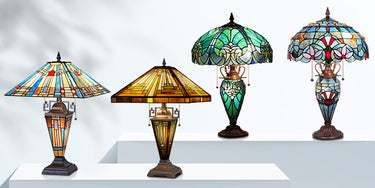
The Lamp That Changed Everything: The Untold Story of Tiffany Glass
How one man's obsession with light and color created the most beloved lamp in history — and why the world still can't get enough of it.
It started with a problem.
In the 1890s, Louis Comfort Tiffany was frustrated. He was one of America's most celebrated designers — a man who had decorated the White House, designed interiors for the ultra-wealthy, and spent decades studying the art of glass. But something was missing.
The electric light bulb had just arrived. It was revolutionary, yes. But it was also harsh, cold, and ugly. It flooded rooms with flat, unforgiving light that stripped away warmth and atmosphere. Tiffany looked at the bare bulb and saw not a miracle, but a problem waiting to be solved.
His solution would change interior design forever.

The Man Behind the Glass
Louis Comfort Tiffany was not a simple craftsman. He was the son of Charles Lewis Tiffany — founder of the famous jewelry house — and he had grown up surrounded by beauty, precision, and the relentless pursuit of perfection.
But Louis wasn't interested in diamonds. He was obsessed with light.
He traveled through Europe and North Africa, studying the way medieval cathedral windows transformed sunlight into something sacred. He spent years experimenting with glass chemistry, developing new formulas that produced colors of extraordinary depth and richness — colors that couldn't be painted on, but existed within the glass itself.
By the time he turned his attention to lamp shades in the early 1890s, he had spent two decades preparing for the moment.
The Birth of an Icon: 1893
The first Tiffany lamp shade appeared around 1893, designed by a woman named Clara Driscoll — the largely uncredited head of Tiffany Studios' women's design department, whose genius would later be recognized by historians as central to the studio's greatest works.
The technique was unlike anything that existed:
- Genuine colored glass — not painted, not coated, but colored all the way through during the manufacturing process
- Copper foil wrapping — each piece of glass wrapped individually in thin copper tape, allowing for curves and intricate shapes impossible with traditional lead came
- Hand soldering — every seam joined by hand, creating the characteristic raised lines that give Tiffany shades their distinctive texture
- Patina finishing — the solder treated with chemicals to achieve the dark, antique appearance that frames each glass piece like a painting
The result was a shade that didn't just cover a light bulb. It transformed it.

The Golden Age: 1900–1933
The decades that followed were extraordinary.
Tiffany Studios produced thousands of designs — from the iconic Wisteria (with its cascading purple blooms and mosaic background) to the beloved Dragonfly, the dramatic Peony, the serene Pond Lily, and hundreds of geometric and nature-inspired patterns in between.
Each shade was a collaboration between designer, glassmaker, and the light itself. No two were identical. The glass was selected piece by piece for its color, texture, and opacity — the way a painter selects pigments, but with the added dimension of light passing through.
The lamps became status symbols. They appeared in the homes of industrialists, artists, and socialites. They were exhibited at world's fairs. They were written about in newspapers as examples of American craft at its finest.
And then, almost overnight, they fell out of fashion.

The Fall — and the Resurrection
By the 1930s, Art Nouveau had given way to Art Deco. Clean lines replaced organic curves. Tiffany Studios closed in 1933, and Louis Comfort Tiffany died two years later, largely forgotten by the design world that had once celebrated him.
For decades, his lamps sat in attics and antique shops, undervalued and overlooked.
Then, in 1958, a single auction changed everything.
A collection of Tiffany lamps sold at Parke-Bernet Galleries in New York for prices that shocked the art world. Collectors who had dismissed the lamps as Victorian curiosities suddenly recognized what they had been ignoring: objects of extraordinary beauty and craftsmanship, made by a method that could never be fully replicated by machine.
The prices climbed. Then they climbed again. Today, original Tiffany Studios lamps regularly sell at auction for $50,000 to over $1 million. The most exceptional pieces have sold for several million dollars each.

Why the World Still Can't Get Enough
More than a century after the first Tiffany lamp was made, the question isn't why people love them. The question is why they love them so much — and why that love has only grown stronger with time.
1. The Light Is Unlike Anything Else
When genuine stained glass is lit from within, it doesn't just glow — it performs. The colors shift with the time of day. The shadows on the walls move as you walk past. The room feels alive in a way that no modern lighting technology has ever replicated. This is not nostalgia. It is physics. Light through colored glass behaves differently than light through any other material.
2. Every Piece Is Unique
No two Tiffany-style shades are identical. The glass is selected by hand. The cutting is done by hand. The soldering is done by hand. Even two shades made from the same pattern will differ in subtle ways — a slightly deeper blue here, a more translucent amber there. In a world of mass production, this kind of individuality is increasingly rare and increasingly valued.
3. They Transcend Trends
Art Nouveau came and went. Mid-Century Modern came and went. Minimalism came and went. Tiffany lamps outlasted all of them — because they don't belong to any trend. They belong to a tradition of craft that predates modern design movements and will outlast whatever comes next.
4. They Make a Room Feel Like a Home
A Tiffany lamp doesn't just light a space. It anchors it. It gives a room a focal point, a warmth, a sense that someone cared about how the light falls. In an era of smart bulbs and recessed lighting, that quality is not just appealing — it's irreplaceable.

From Museum to Living Room
Today, the tradition that Louis Comfort Tiffany began continues in the hands of skilled craftspeople around the world. Quality Tiffany-style lamps — made with genuine stained glass and traditional copper foil construction — bring the same warmth, the same artistry, and the same transformative quality of light into everyday homes.
Not as imitations. As continuations.
The lamp that changed everything in 1893 is still changing rooms today. And if the last century is any guide, it will be doing the same thing a hundred years from now.
Some things are worth doing slowly. Stained glass is one of them.
[Explore the Collection →]