


What Is a Tiffany Lamp? The Complete Guide to Stained Glass Lighting
From a 19th-century studio in New York to living rooms around the world — the story of the most iconic lamp ever made.
If you've ever walked into a room and been stopped by a lamp — truly stopped, the way you stop in front of a painting — there's a good chance it was a Tiffany lamp. Few objects in the history of interior design have achieved what Louis Comfort Tiffany achieved: a lighting fixture so beautiful it became art.
But what exactly is a Tiffany lamp? And how do you choose the right one for your home? This guide covers everything you need to know.
The Origins: Louis Comfort Tiffany
In the late 1800s, Louis Comfort Tiffany — son of the famous jeweler Charles Lewis Tiffany — turned his attention from painting and interior design to glass. He was fascinated by the way medieval cathedral windows used color and light, and he wanted to bring that same magic into the home.
In 1893, his studio produced the first Tiffany lamp. It was revolutionary. Instead of using paint to add color to glass, Tiffany used naturally colored glass — selecting each piece for its hue, texture, and the way it would interact with light. The pieces were then cut, shaped, and joined with copper foil and lead solder, a technique that allowed for far more intricate designs than traditional leaded glass.
The result was unlike anything the world had seen: a lamp that didn't just illuminate a room, but transformed it.
How Tiffany Lamps Are Made
Authentic Tiffany-style lamps follow the same fundamental process developed over a century ago:
- Glass selection — Each piece of stained glass is chosen for its color, opacity, and texture. No two pieces are identical.
- Pattern cutting — The glass is cut to precise shapes following a detailed pattern template.
- Copper foiling — Each glass piece is wrapped in copper foil tape along its edges.
- Soldering — The foiled pieces are soldered together, creating the structural framework of the shade.
- Finishing — The solder lines are treated with patina to achieve the characteristic dark, antique finish.
This process is entirely handcrafted, which is why no two Tiffany-style shades are ever exactly alike — and why they carry such lasting value.
The Most Iconic Tiffany Designs
Over the decades, certain patterns have become classics:

- 🌸 Peony & Floral — Lush, painterly, and richly colored. The most celebrated of all Tiffany designs.
- 🐉 Dragonfly — Delicate and nature-inspired, with jewel-toned wings that glow beautifully when lit.
- 🌿 Wisteria — Cascading purple blooms on a mosaic background. One of the rarest and most valuable originals.
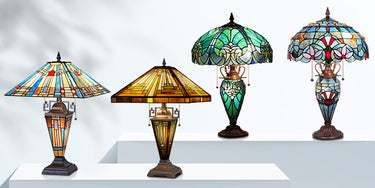
- 🔷 Geometric / Mission — Clean lines and repeating patterns for a more understated, Arts & Crafts aesthetic.
- 🌊 Nautical & Nature — Seagrass, water lilies, and coastal motifs that bring the outdoors in.

Original vs. Tiffany-Style: What's the Difference?
Original Tiffany Studios lamps — produced between 1893 and 1933 — are museum pieces. They sell at auction for tens of thousands to millions of dollars and are rarely found outside of collections.
Tiffany-style lamps, like those made by Capulina, honor the same handcrafted tradition using genuine stained glass and the same copper foil technique. They bring the artistry and warmth of the original into everyday homes — without the museum price tag.
What to look for in a quality Tiffany-style shade:
- ✅ Real stained glass (not plastic or resin)
- ✅ Copper foil construction (not painted or printed patterns)
- ✅ Hand-soldered seams with visible texture
- ✅ Consistent color depth that glows when backlit
Choosing the Right Tiffany Lamp for Your Home

By room:
- Living room — Go bold. A 16" shade in Firecracker or Amber makes a statement.
- Bedroom — Choose calming tones. Blue Dragonfly or Seagrass Blue creates a restful glow.
- Study or reading nook — Mission or Geometric styles offer focused, warm light without distraction.
- Dining room or kitchen — A pendant or chandelier shade adds drama overhead.
By size:
- 7" — Ideal for wall sconces, chandeliers, accent lamps, and small pendants.
- 12" — The most versatile size. Works beautifully on table lamps, torchieres, and pendants.
- 16" — A statement piece. Perfect for floor lamps and larger table lamps in open spaces.

Why Tiffany Lamps Endure
Trends come and go. Tiffany lamps don't. They've outlasted Art Nouveau, Mid-Century Modern, and every minimalist wave in between — because they offer something no trend can replicate: the irreplaceable quality of light through colored glass.
It moves. It shifts with the time of day. It responds to seasons and moods. It makes a room feel alive in a way that no LED panel or smart bulb ever will.
That's not nostalgia. That's craft.

Ready to bring that magic home?
[Explore the Capulina Collection →]