


How to Choose a Replacement Tiffany Lamp Shade: Size, Fit, and Compatibility
A replacement Tiffany-style lamp shade can refresh a favorite lamp without replacing the entire fixture. But finding the right shade takes more than choosing a beautiful pattern.
The shade must work with your lamp’s mounting system, dimensions, and bulb clearance. Two shades that look similar in a photograph may attach differently or sit at very different heights.
Here’s what to check before buying a replacement stained glass lamp shade.

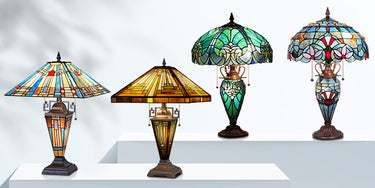
Matching stained glass shades create a coordinated look. Always confirm compatibility with your own fixture before ordering.
1. Identify How Your Current Shade Attaches
Before shopping, switch off the lamp, unplug it, and let the bulb cool. Look at how the existing shade is supported and secured. Take photographs before removing anything.
Some lamps use a threaded rod and a decorative finial to hold the shade in place. Others use a different support or attachment arrangement. A table lamp shade, floor lamp shade, and pendant shade are not automatically interchangeable, even when their dimensions look similar.
Check the replacement shade’s listed mounting details against your existing fixture. Do not assume that a shade includes the hardware needed to attach it.
If the attachment method is unclear, ask for compatibility help before ordering. A clear photograph of the lamp with its shade removed is often more useful than a photograph of the assembled lamp alone.

Look inside the shade as well as at its exterior. The mounting arrangement is essential to checking fit.
2. Measure the Shade, Not Just the Lamp
Use your existing shade as a starting point, especially if you like its current proportions.
Record these measurements:
- Shade width: For a round shade, measure across its widest point. For a square or rectangular shade, record both width and depth.
- Shade height: Measure from the top to the bottom edge.
- Mounting opening: Measure the opening where the shade connects to the fixture, if applicable.
- Overall lamp height: This helps you compare the shade’s scale with the complete lamp.
Also photograph any recessed mounting area or unusual attachment detail. The location of the mounting point can affect how high or low a shade sits, even when two shades have the same overall height.
Do not rely on a product photograph to judge size. Check the listed dimensions and confirm any measurement that is unclear.

This product diagram illustrates width, height, and center-opening measurements for this particular shade. Other models may have different dimensions and mounting requirements.
3. Check the Shade’s Proportions and Stability
A wider shade changes more than the appearance of your lamp. It may extend beyond a small bedside table, sit too close to a wall, or interfere with nearby furniture.
A replacement shade may also differ in weight from the original. Your lamp’s base and shade support need to be suitable for the replacement.
Before choosing a larger shade, consider:
- Whether the lamp base provides appropriate support.
- Whether the shade will fit comfortably in its intended location.
- Whether the switch will remain easy to reach.
- Whether the shade will obstruct your view or crowd nearby objects.
When size or weight compatibility is uncertain, have the fit assessed before using the lamp. Do not force a shade onto an unsuitable support or improvise an attachment.
4. Confirm Bulb Clearance and Fixture Requirements
A replacement shade needs enough space around the bulb and socket. A shade that fits the mounting point may still be unsuitable if its shape brings the glass or other components too close to the bulb.
Follow the lamp manufacturer’s requirements for bulb type, size, and maximum wattage. Changing the shade does not increase the fixture’s permitted wattage.
If you use an LED bulb, check its physical dimensions as well as its electrical compatibility. Bulbs with the same base can have different shapes and sizes.
Avoid using a shade if it touches the bulb, prevents proper assembly, or requires you to alter the socket or wiring. Consult a qualified professional if the fixture needs modification.
5. Choose a Pattern That Works With Your Space
Once compatibility is confirmed, you can focus on the design.
A dragonfly or floral shade can become a decorative focal point. A geometric Mission-style shade can introduce a more structured pattern. Consider whether you want the replacement to echo colors already in your room or introduce a contrasting accent.
Where available, compare photographs of the shade both illuminated and switched off. Colored glass can look different depending on the bulb, surrounding light, and your screen.
If you are replacing only one shade in a coordinated arrangement, compare it with the other lamps in the room. A related color palette can help different patterns feel connected without requiring an exact match.

Consider the glass colors and pattern alongside the mounting details when comparing replacement shades.
6. What to Send When Asking for Compatibility Help
You do not need to know every lighting term to ask a useful question. A few photographs and measurements can make the discussion much easier.
Before contacting the seller, prepare:
- A photograph of the complete lamp.
- A close-up of the shade’s attachment point.
- A photograph of the support and socket with the shade removed, if it can be removed safely.
- The existing shade’s width and height.
- The mounting-opening measurement, where applicable.
- The lamp’s model number or product label, if available.
- The replacement shade you are considering.
If you are replacing a damaged shade, avoid handling broken glass to obtain measurements. Use existing product details or photographs where possible.
Common Replacement-Shade Mistakes to Avoid
Buying by diameter alone. Width matters, but mounting style, height, weight, and bulb clearance matter too.
Assuming every Tiffany-style shade fits every Tiffany-style lamp. A shared decorative style does not establish mechanical compatibility.
Expecting all mounting hardware to be included. Check what comes with the shade before placing an order.
Choosing a much larger shade without checking support. A bigger shade may not be appropriate for the existing lamp base or support system.
Using a shade change as a reason to install a higher-wattage bulb. Always follow the fixture’s original requirements.
A Beautiful Match Starts With the Right Fit
The best replacement Tiffany lamp shade is one that looks right and fits your fixture correctly.
Start with the mounting system, compare the measurements, and check support and bulb clearance. Then choose the colors and pattern that suit your home.
Explore the replacement shade options at TiffanyLampUSA and review the details of each listing. If you are unsure about compatibility, contact us with photographs and measurements before ordering so we can help you assess the fit.